Air handling unit monitoring dashboard
HVAC Monitoring

Air Handling Unit (AHU) Monitoring System

Monitor AHU temperature, humidity, fan status, filter differential pressure and energy consumption with NBSense IoT-based AHU monitoring solutions.

13-PointImplementation Scope
Supply / ReturnAir Temperature & Humidity
Filter ΔPDifferential Pressure Alerts
Unit-wiseCentralized Dashboard
Overview

Air Handling Unit (AHU) Monitoring System

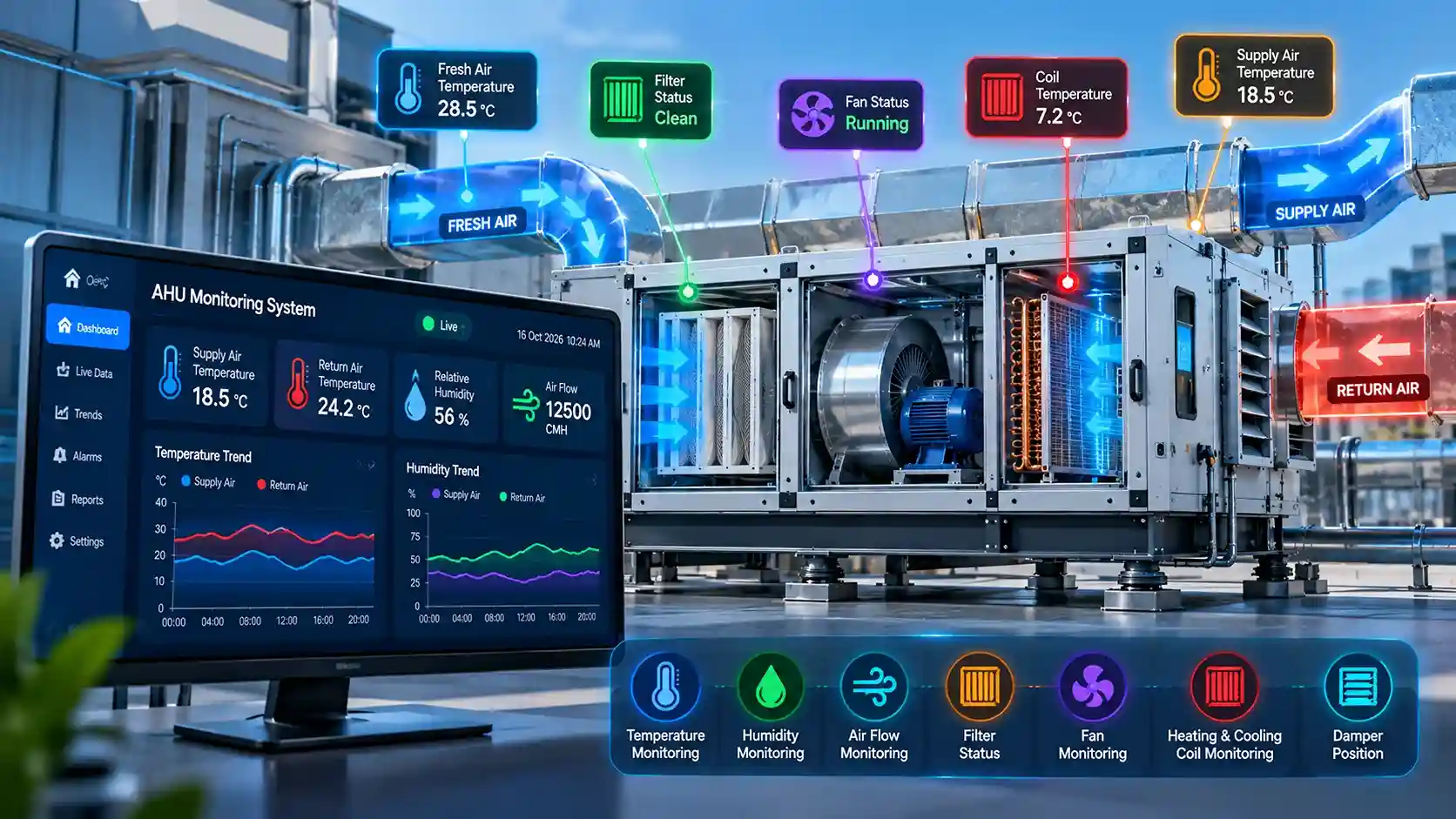
Air Handling Units are important components of HVAC installations in commercial buildings, hospitals, offices, industrial facilities and large infrastructure projects. AHUs support air circulation, filtration, heating, cooling and humidity management.

Monitoring AHU operating parameters helps facility teams understand equipment status and identify conditions that may require inspection or maintenance. NBSense provides AHU monitoring implementation services to integrate compatible controllers, sensors and meters with a centralized monitoring platform.

Depending on the project, monitoring can include supply and return air temperature, humidity, fan status, filter differential pressure, duct pressure and electrical consumption.

Primary Objectives

Monitor AHU operating status and selected parameters.
Track supply and return air conditions.
Monitor filter differential pressure where instruments are installed.
Identify abnormal temperature, pressure or equipment conditions.
Track electrical consumption where suitable meters are available.
Support maintenance planning and HVAC performance reviews.
Scope of work

Detailed Scope of Work

Our implementation services cover thirteen distinct steps to deliver a fully functional AHU monitoring solution.

01

Site Survey and AHU Assessment

  • Survey the AHUs selected for monitoring, including fan assemblies, filters, cooling and heating coils, dampers, associated control panels and available sensors.
  • Review equipment schedules, controller documentation and existing BMS arrangements where available.
02

Monitoring Point Schedule

  • Identify the parameters to be monitored for each AHU.
  • Prepare a point schedule that specifies sensor locations, controller data points, required measurements and dashboard organization.
03

Temperature and Humidity Monitoring

  • Integrate existing sensors or install suitable temperature and humidity sensors at approved supply air, return air or other relevant locations.
  • Configure the measurement units, intervals and thresholds.
04

Fan Status Monitoring

  • Integrate compatible run, stop and fault signals from AHU fans or associated motor control systems.
  • Where required, capture operating hours and status changes from available interfaces.
05

Filter Differential Pressure Monitoring

  • Install or integrate suitable differential pressure sensors across filters where included in the scope.
  • Configure readings and alerts based on agreed maintenance thresholds.
06

Duct Pressure and Airflow Monitoring

  • Where specified, integrate suitable duct pressure or airflow sensors.
  • Confirm instrument selection and placement based on the duct arrangement and measurement requirements.
07

Controller Integration

  • Integrate compatible AHU controllers using supported protocols or approved signal interfaces.
  • Map available operating modes, alarm conditions and other relevant data points.
08

Electrical Monitoring

  • Where required, integrate electrical meters or compatible drive data to monitor fan motor power, energy consumption and selected operating parameters.
09

Dashboard Development

  • Configure an AHU-wise dashboard displaying equipment status, temperatures, humidity, filter differential pressure and other selected parameters.
  • Organize the dashboard by building, floor or ventilation zone where applicable.
10

Alert Configuration

  • Configure notifications for selected abnormal conditions, such as high filter differential pressure, temperature deviations, fan faults and communication loss where supported.
11

Historical Data and Reporting

  • Configure trends and reports for AHU status, temperature readings, filter pressure and energy consumption where available.
  • Reports may support maintenance reviews and equipment performance comparisons.
12

Testing and Commissioning

  • Verify sensor operation, controller communication, parameter mapping, status signals and alert functionality.
  • Ensure that monitoring installation does not interfere with the existing AHU controls.
13

Documentation and Handover

  • Provide the AHU point schedule, sensor mapping, controller interface details, alert configuration and operating instructions.
Methodology

From assessment to handover, in seven steps

  1. Step 1Site Survey & AHU Assessment
  2. Step 2Temperature & Humidity Monitoring
  3. Step 3Filter Differential Pressure Monitoring
  4. Step 4Controller Integration
  5. Step 5Dashboard Development
  6. Step 6Historical Data & Reporting
  7. Step 7Documentation & Handover
Outcomes

Project Deliverables and Benefits

Project Deliverables

  • AHU monitoring design and point schedule.
  • Connected sensors and controller integration within the approved scope.
  • AHU-wise monitoring dashboard.
  • Temperature, humidity and equipment status monitoring.
  • Filter differential pressure monitoring where specified.
  • Energy monitoring and alerts where included.
  • Testing and commissioning documentation.

Expected Benefits

  • AHU monitoring can improve visibility into air handling operations, support filter maintenance planning, help identify equipment abnormalities and provide useful data for HVAC performance reviews.

Scope Clarifications

Air balancing, filter replacement, duct cleaning, coil cleaning, automatic damper control and AHU refurbishment are not included unless specifically agreed. Airflow calculations and energy efficiency analysis depend on the installed instrumentation and available data.

Instrumentation

Monitored Parameters & Integration

System ComponentMonitored Parameters
Air ConditionsSupply and return air temperature, humidity and duct pressure
Fans & FiltersSupply/return fan status, run hours and filter differential pressure
ElectricalEnergy consumption and selected electrical parameters
Alerts & DiagnosticsThreshold alerts, controller alarms and communication loss
FAQ

Frequently asked questions

Still have a question about scope, timelines or data? Our team is happy to help.

Pravin@nbri.in
Can you integrate with our existing AHU controllers?

Yes, where the controllers offer compatible communication interfaces. Supported points are mapped to the NBSense platform; additional sensors can be installed where controller data is not available.

Does the system tell us when filters need replacement?

Filter differential pressure can be monitored and alert limits configured, helping teams decide when filters need inspection. Filter replacement itself is not part of the scope unless agreed.

Will this control the AHU automatically?

No. The scope covers monitoring. Automatic damper control, air balancing and AHU refurbishment are excluded unless specifically agreed.

Get clear visibility into every AHU

Monitor your AHUs more effectively with NBSense. Contact us to discuss your building's AHU monitoring requirements.

Share this page:
⚡

Connect With Us

📞 Call 💬 WhatsApp 🧑‍💼 Consultation