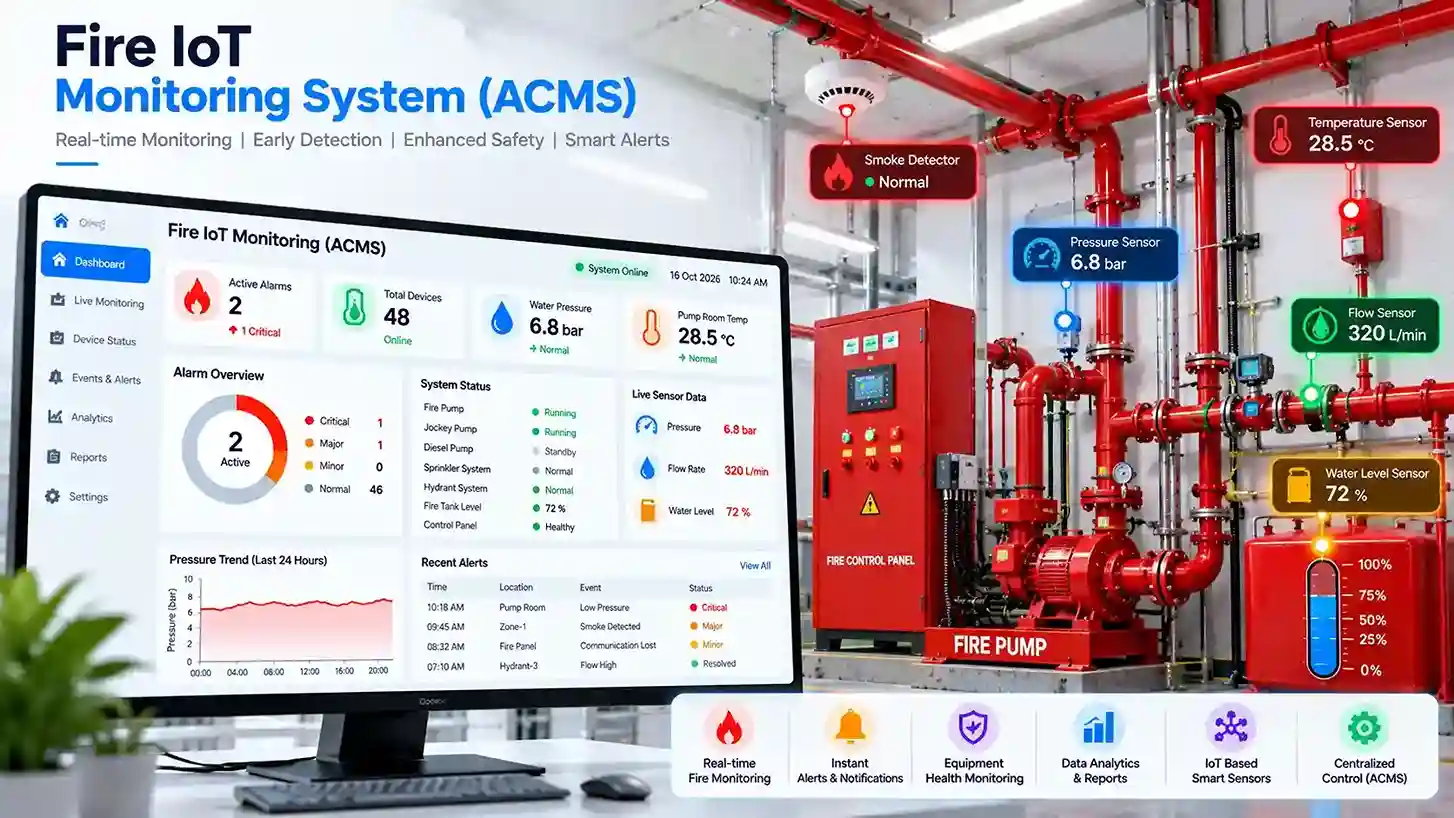
Fire IoT monitoring ACMS dashboard
Fire Safety

Fire IoT Monitoring System (ACMS)

Monitor fire pumps, hydrant pressure, tank levels, fire alarm panels and critical fire safety equipment with NBSense IoT-based ACMS solutions.

13-PointImplementation Scope
Fire PumpsStatus & Faults
HydrantPressure Monitoring
24×7Centralized ACMS View
Overview

Fire IoT Monitoring System (ACMS)

Fire safety systems are critical for protecting people, buildings, industrial facilities and infrastructure. Continuous visibility into the operating status of fire protection equipment helps facility teams identify abnormal conditions and coordinate timely inspections and maintenance.

NBSense provides Fire IoT Monitoring and Alarm Monitoring System (ACMS) implementation services to integrate compatible fire protection equipment with a centralized monitoring platform. Depending on the approved project design, the system can monitor fire pump status, hydrant pressure, fire water tank levels, fire alarm panel signals, diesel generator parameters and other selected fire safety equipment.

The solution is intended to supplement existing fire protection systems by providing additional visibility into equipment status and selected operating parameters. It can support centralized monitoring across commercial buildings, hospitals, industrial facilities, campuses, warehouses and other applicable sites.

Primary Objectives

Monitor the status of selected fire protection equipment.
Provide centralized visibility into critical fire safety systems.
Identify equipment faults and abnormal operating conditions where supported.
Configure alerts for agreed status changes and threshold violations.
Maintain historical records for operational review.
Support maintenance coordination and fire safety system readiness monitoring.
Scope of work

Detailed Scope of Work

Our implementation services cover thirteen distinct steps to deliver a fully functional fire equipment monitoring solution.

01

Site Survey and Fire System Assessment

  • Survey the existing fire protection infrastructure, including fire alarm panels, fire pumps, jockey pumps, hydrant networks, sprinkler systems, fire water tanks and associated equipment where installed.
  • Review available fire system drawings, equipment schedules, panel interfaces and existing monitoring arrangements.
  • Identify the systems and parameters that can be monitored without interfering with the approved fire protection design.
02

Monitoring Architecture and Point Identification

  • Prepare an ACMS monitoring architecture covering field signals, compatible interface modules, IoT gateways, communication arrangements and the centralized dashboard.
  • Develop a monitoring-point list that identifies each equipment item, signal type, operating state and required notification.
03

Fire Pump Monitoring

  • Identify available signals for main fire pumps, jockey pumps and other installed fire pumps.
  • Integrate compatible run status, fault status, power availability and other approved signals where available.
  • Configure equipment-wise status displays and historical event records.
  • Pump operation monitoring must not interfere with the operation of the fire protection system.
04

Fire Water Tank Level Monitoring

  • Where included, install or integrate suitable tank level sensors to monitor fire water storage.
  • Configure low-level and other agreed threshold alerts based on the approved tank configuration and operating requirements.
05

Hydrant and Sprinkler Pressure Monitoring

  • Install or integrate compatible pressure transmitters at approved measurement points where continuous pressure monitoring is required.
  • Configure pressure readings and alerts based on the agreed operating limits.
06

Fire Alarm Panel Integration

  • Review the existing fire alarm control panel and its supported interfaces.
  • Integrate approved alarm, fault and system-status signals using manufacturer-compatible interfaces and methods authorized by the responsible fire safety team.
  • The integration must preserve the independent operation and required functionality of the existing fire alarm system.
07

Supporting Equipment Monitoring

  • Where included in the project, integrate selected parameters from fire pump controllers, diesel generators, battery systems, fire doors, ventilation systems or other associated fire safety equipment.
  • Only available and technically compatible signals should be included in the final design.
08

IoT Gateway and Communication Setup

  • Configure the required interface modules and communication gateways.
  • Establish device identification, signal mapping, communication parameters and data acquisition intervals.
09

Centralized ACMS Dashboard

  • Configure dashboards showing connected equipment, operating status, alarms, faults and selected sensor readings.
  • Organize information by building, floor, fire zone or equipment category as required.
10

Alerts and Event Notifications

  • Configure approved notifications for fire alarm signals, equipment faults, pump status changes, low tank levels, pressure deviations and communication loss where supported.
  • Alert recipients, escalation arrangements and notification channels must be agreed with the client.
  • Digital notifications must not replace mandatory local alarms or emergency response procedures.
11

Historical Event Logging and Reports

  • Configure event history, timestamps, equipment-wise records and reporting functions where supported by the platform.
  • This information can help facility teams review recurring faults and monitor system availability.
12

Testing and Commissioning

  • Conduct functional checks of connected monitoring points, alarm transmission, communication and dashboard presentation.
  • Test scenarios must be coordinated with the fire safety team to avoid unintended alarms, equipment operation or disruption of protection systems.
13

Documentation and Handover

  • Provide the approved monitoring-point list, interface details, device mapping, configuration records, testing results and operating instructions.
  • Explain dashboard usage and alert acknowledgement procedures to designated personnel.
Methodology

From assessment to handover, in seven steps

  1. Step 1Site Survey & Fire System Assessment
  2. Step 2Fire Pump Monitoring
  3. Step 3Hydrant & Sprinkler Pressure Monitoring
  4. Step 4Supporting Equipment Monitoring
  5. Step 5Centralized ACMS Dashboard
  6. Step 6Historical Event Logging & Reports
  7. Step 7Documentation & Handover
Outcomes

Project Deliverables and Benefits

Project Deliverables

  • ACMS monitoring architecture and point schedule.
  • Compatible fire system interfaces and gateways within the approved scope.
  • Centralized fire equipment monitoring dashboard.
  • Configured status, fault and threshold notifications.
  • Historical event records and reports where supported.
  • Testing and commissioning documentation.
  • User training and system handover.

Expected Benefits

  • The system can improve visibility into selected fire protection equipment, help personnel identify reported faults and support more structured maintenance monitoring.
  • Actual performance depends on the installed interfaces, signal availability, communication reliability and response procedures.

Scope Clarifications

The ACMS monitoring layer does not replace the fire alarm control panel, fire protection equipment, mandatory inspections, fire audits, statutory approvals or emergency response arrangements. Fire suppression activation, pump control and other safety-critical control functions are excluded unless separately engineered, approved and specified. Statutory compliance must be assessed against applicable requirements for the particular site.

Instrumentation

Monitored Parameters & Integration

System ComponentMonitored Parameters
Fire PumpsJockey, main and diesel pump status, run and fault signals
Hydrant & SprinklerLine pressure at selected points
Fire Water TanksTank water level and low-level alerts
Fire Alarm PanelFire, fault and supervisory signals where available
FAQ

Frequently asked questions

Still have a question about scope, timelines or data? Our team is happy to help.

Pravin@nbri.in
Does ACMS replace our fire alarm panel?

No. The ACMS monitoring layer supplements existing fire protection systems. It does not replace the fire alarm control panel, fire protection equipment, inspections or emergency response arrangements.

Can the system start fire pumps remotely?

Fire suppression activation, pump control and other safety-critical control functions are excluded unless separately engineered, approved and specified.

Which equipment can be monitored?

Depending on the design: fire pump status, hydrant pressure, fire water tank levels, fire alarm panel signals, diesel generator parameters and other compatible fire safety equipment.

Improve visibility into your fire safety infrastructure

Improve visibility into your fire safety infrastructure with NBSense Fire IoT Monitoring and ACMS solutions. Contact us to discuss your building or industrial facility requirements.

Share this page:
⚡

Connect With Us

📞 Call 💬 WhatsApp 🧑‍💼 Consultation