HVAC monitoring dashboard
HVAC Monitoring

HVAC Monitoring System

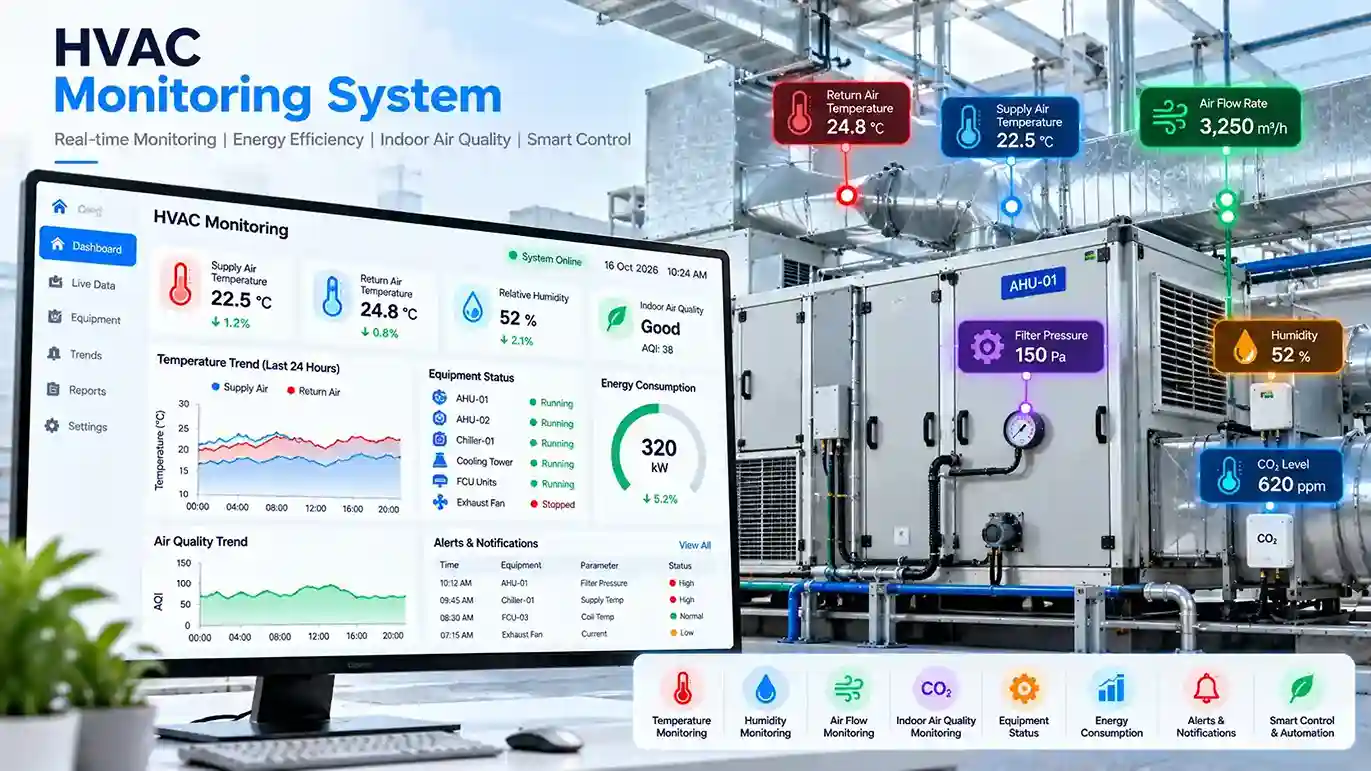
Monitor HVAC operating status, temperature, humidity, energy consumption and equipment performance with NBSense IoT-based HVAC monitoring solutions.

12-PointImplementation Scope
Multi-EquipmentSingle Dashboard
Temp & RHEnvironmental Monitoring
EnergyConsumption Visibility
Overview

HVAC Monitoring System

Heating, Ventilation and Air Conditioning (HVAC) systems are essential for maintaining indoor comfort, air circulation and environmental conditions in commercial buildings, hospitals, industrial facilities, offices and large infrastructure projects.

Without centralized monitoring, facility teams may need to check multiple control panels and equipment systems separately. This can make it difficult to identify abnormal operating conditions, understand energy consumption and maintain consistent operating performance.

NBSense provides HVAC monitoring system implementation services to connect compatible HVAC equipment, controllers, sensors and electrical meters to a centralized monitoring platform. The system can provide visibility into selected operating parameters, equipment status, environmental readings and energy consumption.

Primary Objectives

Monitor HVAC equipment and operating conditions centrally.
Track temperature, humidity and other selected environmental parameters.
Monitor electrical consumption where suitable meters are installed.
Identify equipment faults and abnormal operating conditions where supported.
Improve operational visibility and maintenance coordination.
Support energy performance reviews and building management.
Scope of work

Detailed Scope of Work

Our implementation services cover twelve distinct steps to deliver a fully functional HVAC monitoring solution.

01

Site Survey and HVAC Assessment

  • Survey the existing HVAC installation, including air conditioning units, chillers, AHUs, ventilation systems, pumps, cooling towers and associated electrical panels where applicable.
  • Review available HVAC drawings, equipment schedules, controller details and existing building management systems.
02

Monitoring Architecture and Point Schedule

  • Prepare a monitoring architecture defining the required sensors, controller interfaces, gateways, communication networks and dashboard structure.
  • Identify the parameters and operating signals to be monitored for each equipment category.
03

HVAC Equipment Integration

  • Assess the availability of communication interfaces from existing HVAC controllers and equipment.
  • Integrate compatible operating signals and parameters using supported protocols such as BACnet, Modbus or manufacturer-specific interfaces where technically available.
04

Temperature and Humidity Monitoring

  • Install or integrate suitable temperature and humidity sensors at agreed locations.
  • Configure measurement units, sensor identification, data intervals and monitoring zones.
05

Equipment Status Monitoring

  • Configure monitoring for available equipment states, including running, stopped, fault and operating modes where supported by the equipment interface.
06

Airflow and Pressure Monitoring

  • Where required, integrate suitable sensors to monitor selected airflow, duct pressure, filter differential pressure or other HVAC parameters.
  • Confirm measurement locations and instrument specifications before implementation.
07

Electrical Energy Monitoring

  • Integrate compatible energy meters to capture selected electrical parameters for HVAC equipment.
  • Configure energy consumption and power trends where dedicated measurements are available.
08

Centralized Dashboard Configuration

  • Develop dashboards displaying selected equipment status, environmental readings, electrical measurements, alarms and historical trends.
  • Organize the display by building, floor, zone or equipment group.
09

Alerts and Notifications

  • Configure notifications for agreed abnormal conditions, such as temperature deviations, equipment faults, communication loss or selected pressure and energy thresholds.
10

Historical Data and Reports

  • Configure historical charts and reports for selected operating parameters.
  • Where sufficient data is available, provide equipment-wise operating summaries and energy consumption comparisons.
11

Functional Testing

  • Verify device communication, controller integration, sensor readings, parameter mapping, dashboard values and configured alerts.
  • Check that monitoring integration does not interfere with existing HVAC controls.
12

Documentation and Handover

  • Provide the monitoring-point list, interface details, configuration records, dashboard instructions and commissioning documentation.
  • Conduct user training for designated facility personnel.
Methodology

From assessment to handover, in seven steps

  1. Step 1Site Survey & HVAC Assessment
  2. Step 2HVAC Equipment Integration
  3. Step 3Equipment Status Monitoring
  4. Step 4Electrical Energy Monitoring
  5. Step 5Centralized Dashboard Configuration
  6. Step 6Historical Data & Reports
  7. Step 7Documentation & Handover
Outcomes

Project Deliverables and Benefits

Project Deliverables

  • HVAC monitoring architecture and point schedule.
  • Compatible sensor and controller integration within the approved scope.
  • Centralized HVAC dashboard.
  • Equipment status and environmental monitoring.
  • Energy monitoring where specified.
  • Configurable alerts and historical reports.
  • Testing, commissioning and handover documentation.

Expected Benefits

  • HVAC monitoring can improve operational visibility, help identify equipment abnormalities, support energy consumption reviews and provide historical data for maintenance planning.
  • Actual energy savings depend on operating conditions and any corrective measures taken.

Scope Clarifications

HVAC monitoring is not equivalent to a complete Building Management System (BMS). Automatic control, setpoint optimization, equipment sequencing, refrigeration repairs, duct modifications and HVAC commissioning services must be separately specified where required.

Instrumentation

Monitored Parameters & Integration

System ComponentMonitored Parameters
HVAC EquipmentChillers, AHUs, FCUs, pumps and fans via compatible controllers
EnvironmentRoom, supply and return temperature and humidity
Airflow & PressureDuct pressure, differential pressure and airflow
ElectricalEquipment-wise energy consumption
FAQ

Frequently asked questions

Still have a question about scope, timelines or data? Our team is happy to help.

Pravin@nbri.in
Is this the same as a Building Management System (BMS)?

No. HVAC monitoring is not equivalent to a complete BMS. Automatic control, setpoint optimization and equipment sequencing must be separately specified where required.

Can you connect equipment from different manufacturers?

Yes, where the equipment and controllers support compatible communication interfaces. Supplementary sensors can be installed where controller data is unavailable.

Will we receive alerts for abnormal conditions?

Yes. Threshold and status alerts are configured for agreed conditions such as high temperature, equipment trips and communication loss.

Bring all your HVAC data into one view

Get better visibility into your building's HVAC performance with NBSense. Contact us to discuss your HVAC monitoring requirements.

Share this page:
⚡

Connect With Us

📞 Call 💬 WhatsApp 🧑‍💼 Consultation