Industrial air quality monitoring dashboard
Environmental Monitoring

Industrial and Indoor Air Quality Monitoring System

Monitor indoor, outdoor and industrial air quality with NBSense solutions for particulate matter, gases, CO₂, temperature, humidity and configurable alerts.

13-PointImplementation Scope
PM / GasesSelected Pollutants
CO₂ & VOCIndoor Air Quality
Location-wiseTrends & Alerts
Overview

Industrial and Indoor Air Quality Monitoring System

Air quality monitoring helps organizations understand environmental conditions in workplaces, industrial facilities, commercial buildings, production areas and other locations where air quality is important.

NBSense provides air quality monitoring implementation services using suitable sensors, analysers and connected monitoring platforms. Depending on the project requirements, the system may monitor particulate matter, selected gases, carbon dioxide, volatile organic compounds, temperature, humidity and other relevant parameters.

The monitoring solution is designed according to the intended application, the pollutants of interest, environmental conditions, required measurement ranges and applicable monitoring standards.

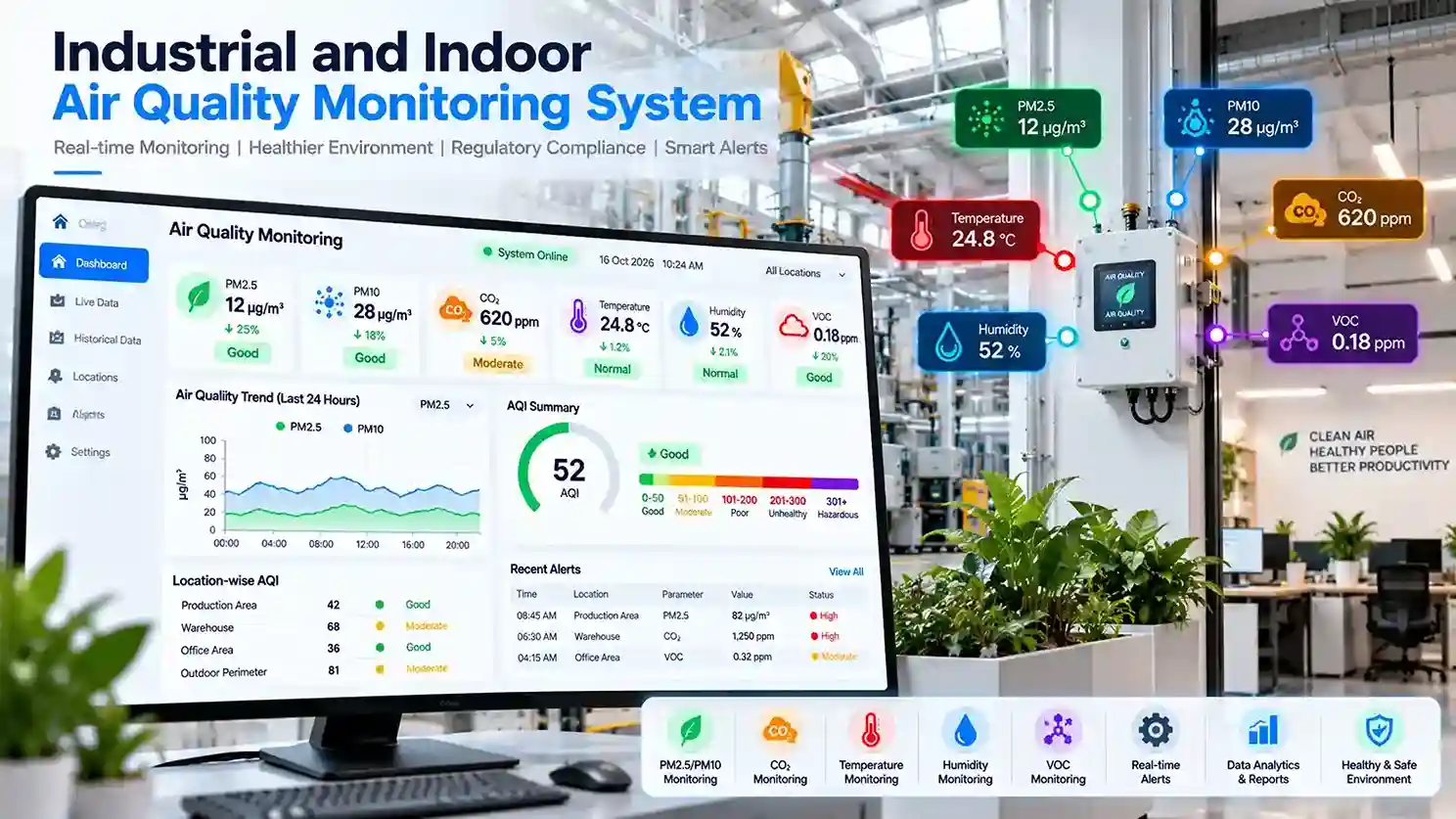
Primary Objectives

Measure selected air quality parameters at designated locations.
Provide centralized access to current readings and historical trends.
Identify conditions that exceed agreed thresholds.
Improve visibility into workplace or facility environmental conditions.
Support ventilation reviews and environmental management.
Maintain monitoring records for operational analysis.
Scope of work

Detailed Scope of Work

Our implementation services cover thirteen distinct steps to deliver a fully functional air quality monitoring solution.

01

Site Survey and Air Quality Assessment

  • Review the facility layout, activities, ventilation arrangements, potential emission sources and intended monitoring objectives.
  • Identify whether monitoring is required indoors, outdoors or in specific industrial process areas.
02

Parameter Selection

  • Confirm the parameters to be measured based on the application.
  • Depending on the project, these may include:
    • PM2.5 and PM10 particulate matter.
    • Carbon dioxide (CO₂).
    • Carbon monoxide (CO).
    • Selected volatile organic compounds (VOCs).
    • Temperature and relative humidity.
    • Other gases or pollutants where suitable instruments are specified.
  • Not every sensor is suitable for every pollutant or environment; the final instrument selection must match the required application.
03

Monitoring Location Planning

  • Identify suitable sensor locations and mounting heights based on the monitoring objective.
  • Consider airflow, ventilation outlets, pollutant sources, occupancy, ambient conditions and instrument installation requirements.
04

Sensor and Analyser Selection

  • Select compatible sensors or analysers based on the required measurement range, detection capability, expected environmental conditions and applicable accuracy requirements.
  • Confirm whether the project requires indicative environmental monitoring or measurements suitable for a defined compliance programme.
05

Sensor Installation and Configuration

  • Install instruments at approved locations and configure parameter ranges, units, data intervals and device identifiers.
  • Provide suitable mounting and protection for the operating environment.
06

IoT Connectivity and Data Acquisition

  • Connect compatible monitoring devices to the gateway and central platform.
  • Configure communication interfaces, data mapping, timestamps and measurement intervals.
07

Air Quality Dashboard

  • Develop a centralized dashboard displaying current readings, selected environmental indicators, location-wise information and historical trends.
  • Organize the dashboard by building, floor, department or monitoring zone where required.
08

Threshold Configuration and Alerts

  • Establish client-approved thresholds for the selected parameters.
  • Configure notifications when readings exceed or fall below agreed limits, where supported by the instruments and platform.
09

Environmental Trend Reporting

  • Configure historical graphs and reports to help users examine changes over time, compare monitoring locations and identify recurring conditions that may need investigation.
10

Ventilation and Operational Review Support

  • Where relevant, provide monitoring data that can support ventilation assessments and operational reviews.
  • Any ventilation recommendations, system balancing or control modifications should be defined as separate engineering work unless included in the project.
11

Instrument Verification and Maintenance Planning

  • Verify device operation, communication and measurement presentation.
  • Document instrument maintenance and calibration requirements based on manufacturer recommendations and the intended application.
12

Testing and Commissioning

  • Test sensor data acquisition, dashboard functionality, configured alerts and communication status.
  • Record the completed checks and any agreed limitations.
13

Documentation and Handover

  • Provide the instrument list, pollutant mapping, monitoring locations, configured thresholds, operating instructions and commissioning records.
Methodology

From assessment to handover, in seven steps

  1. Step 1Site Survey & Air Quality Assessment
  2. Step 2Monitoring Location Planning
  3. Step 3Sensor Installation & Configuration
  4. Step 4Air Quality Dashboard
  5. Step 5Environmental Trend Reporting
  6. Step 6Instrument Verification & Maintenance Planning
  7. Step 7Documentation & Handover
Outcomes

Project Deliverables and Benefits

Project Deliverables

  • Air quality monitoring design.
  • Selected sensors and analysers within the approved scope.
  • Configured air quality dashboard.
  • Parameter-specific alerts and trend reports.
  • Monitoring-point and instrument documentation.
  • Verification and commissioning records.
  • Operating and maintenance guidance.

Expected Benefits

  • Air quality monitoring can provide greater awareness of environmental conditions and support timely investigation of elevated readings.
  • Historical data may help organizations evaluate changes associated with occupancy, processes or ventilation operation.

Scope Clarifications

Air quality monitoring does not automatically establish statutory compliance or guarantee that an area is safe. Certified testing, industrial hygiene assessments, accredited environmental measurements and regulatory reporting must be separately specified where required. Sensor suitability and measurement limitations should be documented.

Instrumentation

Monitored Parameters & Integration

System ComponentMonitored Parameters
Particulate MatterPM1, PM2.5 and PM10 where included
GasesCO₂, CO, VOCs and other selected gases
EnvironmentTemperature and humidity
AlertsThreshold exceedances and sensor/communication status
FAQ

Frequently asked questions

Still have a question about scope, timelines or data? Our team is happy to help.

Pravin@nbri.in
Which parameters can be monitored?

Depending on the application: particulate matter, selected gases, carbon dioxide, volatile organic compounds, temperature, humidity and other relevant parameters.

Does the system certify statutory compliance?

No. Air quality monitoring does not automatically establish statutory compliance or guarantee that an area is safe. Certified testing and regulatory reporting are separate services.

How is sensor accuracy maintained?

Instrument verification and maintenance planning are part of the scope, including calibration or replacement intervals based on manufacturer recommendations.

Understand the air your people breathe

Improve visibility into air quality across your workplace or industrial facility. Contact NBSense to discuss your air quality monitoring requirements.

Share this page:
⚡

Connect With Us

📞 Call 💬 WhatsApp 🧑‍💼 Consultation