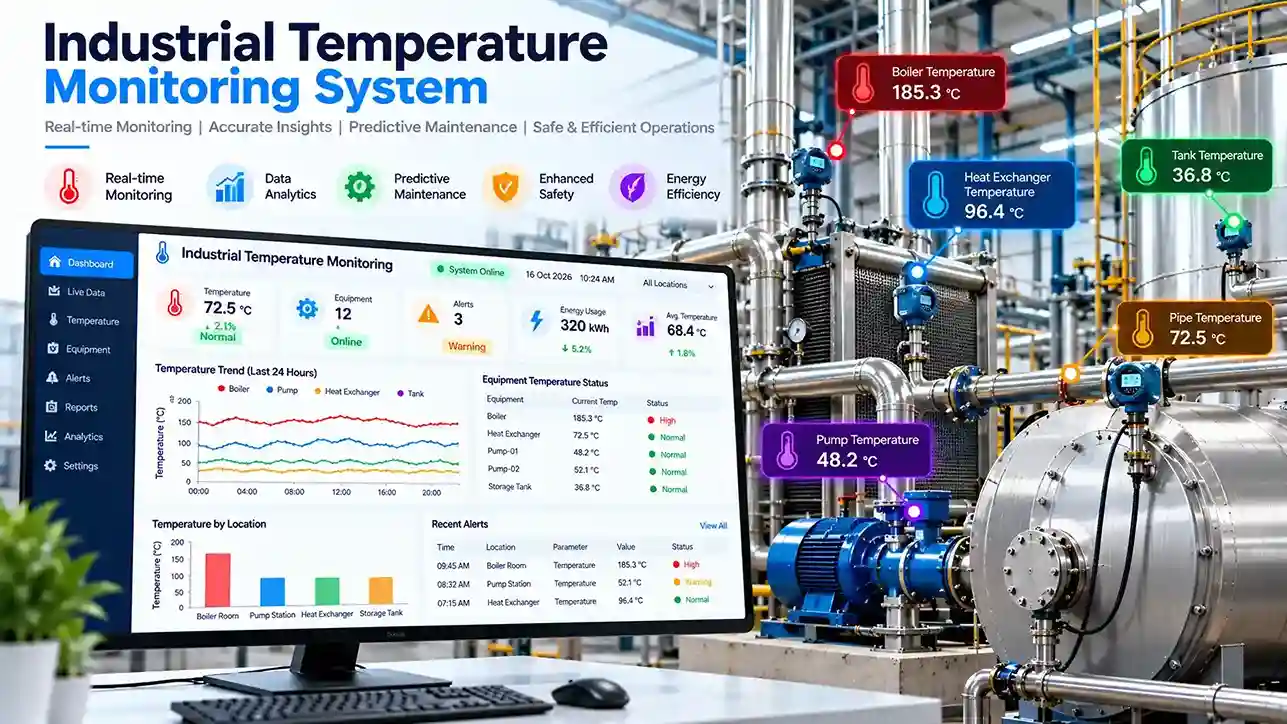
Industrial temperature monitoring dashboard
Thermal Monitoring

Industrial Temperature Monitoring System

Implement real-time temperature monitoring for industrial equipment, process lines, storage areas and facilities with NBSense sensors, dashboards and alerts.

13-PointImplementation Scope
Multi-PointZone Monitoring
Real-timeReadings & Trends
AlertsAgreed Operating Limits
Overview

Industrial Temperature Monitoring System

Temperature is an important operating parameter across manufacturing, electrical infrastructure, HVAC systems, storage facilities, utilities and industrial processes. Excessive or unexpected temperature changes can indicate process deviations, equipment stress or environmental conditions that require attention.

NBSense provides temperature monitoring implementation services using suitable sensors, transmitters, data acquisition equipment and centralized monitoring dashboards. The solution can be designed to measure temperature at individual equipment points, process locations, rooms, storage areas or other designated zones.

The system provides access to current readings and historical temperature trends, along with configurable alerts for agreed operating limits.

Primary Objectives

Monitor temperature continuously or at configured intervals.
Improve visibility into equipment and process temperature conditions.
Identify readings outside defined operating ranges.
Maintain historical records for operational review.
Support environmental and process monitoring.
Provide alerts to designated personnel when configured limits are exceeded.
Scope of work

Detailed Scope of Work

Our implementation services cover thirteen distinct steps to deliver a fully functional temperature monitoring solution.

01

Site Assessment and Temperature Monitoring Requirements

  • Survey the facility and identify the assets, processes, rooms or storage areas that require temperature monitoring.
  • Determine the operating range, measurement locations, environmental conditions and response requirements.
02

Sensor Selection and Technical Assessment

  • Select suitable temperature sensors, probes and transmitters according to the required range, response time, accuracy, mounting method and operating environment.
  • Depending on the application, these may include RTDs, thermocouples or other compatible temperature instruments.
03

Monitoring Point Design

  • Prepare a sensor location schedule and identify the required number of measurement points.
  • Confirm whether each sensor will measure ambient air, surface temperature, process temperature or another defined parameter.
04

Sensor Installation

  • Install sensors at approved locations using appropriate mounting accessories and installation methods.
  • Ensure that placement is suitable for the intended measurement and does not interfere with equipment operation.
05

Device Configuration

  • Configure sensor ranges, measurement units, identification labels, sampling intervals and communication settings.
  • Map each reading to the correct equipment or monitoring zone.
06

IoT Gateway Integration

  • Connect compatible temperature instruments to the gateway or monitoring platform.
  • Establish data communication and verify that measurements are received and displayed correctly.
07

Real-Time Temperature Dashboard

  • Configure dashboards to display current readings, historical temperature trends, equipment names and monitoring locations.
  • Where required, organize readings by department, zone, process or equipment group.
08

Threshold and Alarm Configuration

  • Set upper and lower temperature limits according to equipment specifications, process requirements or client-approved operating limits.
  • Configure alerts for readings outside those limits and for sensor or communication faults where supported.
09

Historical Data and Trend Analysis

  • Configure historical temperature charts, selected time-period summaries and reports.
  • Trend data can help users review recurring temperature excursions and compare operating conditions over time.
10

Multi-Point and Zone Monitoring

  • Where several sensors are installed, configure a consolidated view of the selected locations.
  • Provide zone-wise monitoring and comparisons where these are included in the project.
11

Instrument Verification

  • Verify sensor installation, measurement units, configured ranges, communication and dashboard values.
  • Compare readings with a suitable reference instrument when required by the project.
12

Testing and Commissioning

  • Test alert conditions using approved procedures, verify data updates and confirm that the configured dashboards display the correct monitoring points.
  • Document the completed commissioning checks.
13

Documentation and Handover

  • Provide the sensor schedule, installation locations, measurement ranges, alert settings, configuration details and operating instructions.
Methodology

From assessment to handover, in seven steps

  1. Step 1Site Assessment & Temperature Monitoring Requirements
  2. Step 2Monitoring Point Design
  3. Step 3Device Configuration
  4. Step 4Real-Time Temperature Dashboard
  5. Step 5Historical Data & Trend Analysis
  6. Step 6Instrument Verification
  7. Step 7Documentation & Handover
Outcomes

Project Deliverables and Benefits

Project Deliverables

  • Temperature monitoring design and sensor schedule.
  • Installed or integrated temperature sensors within the approved scope.
  • Configured dashboard with live readings and trends.
  • Upper and lower threshold alerts.
  • Historical reports and monitoring records.
  • Sensor verification and commissioning documentation.
  • Operating instructions and handover support.

Expected Benefits

  • Temperature monitoring can improve visibility into process and equipment conditions, help identify excursions earlier and support investigation of recurring temperature issues.
  • The value of the system depends on correct sensor placement, suitable instruments and appropriate response procedures.

Scope Clarifications

Automatic cooling, heating control, HVAC control, equipment shutdown and safety interlocks are not included unless expressly specified. Measurement accuracy depends on sensor specifications, installation conditions and calibration practices.

Instrumentation

Monitored Parameters & Integration

System ComponentMonitored Parameters
EquipmentMotors, panels, bearings and machine temperature points
ProcessProcess lines, vessels and pipelines
Rooms & StorageRoom, warehouse and cold storage zones
AlertsHigh/low limits, sensor faults and communication loss
FAQ

Frequently asked questions

Still have a question about scope, timelines or data? Our team is happy to help.

Pravin@nbri.in
What types of temperature sensors are used?

Sensor selection depends on the application, measurement range, accuracy needs and installation conditions, and may include RTDs, thermocouples, wireless or other suitable sensors.

Can multiple rooms or zones be monitored on one dashboard?

Yes. Multi-point and zone monitoring are configured so readings can be grouped by area, equipment or zone.

Will the system control heating or cooling?

No. Automatic cooling, heating control, equipment shutdown and safety interlocks are not included unless expressly specified.

Monitor every critical temperature point

Monitor critical temperatures with greater visibility and control. Contact NBSense to discuss your industrial temperature monitoring requirements.

Share this page:
⚡

Connect With Us

📞 Call 💬 WhatsApp 🧑‍💼 Consultation